
Why Your Wood Pellet Machine Has Low Output? 8 Reasons & Step-by-Step Fixes
Wood pellet mills low output not only affects production efficiency but also directly increases production costs. Many new users often only focus on the pellet machine itself when encountering this problem. However, in reality, raw materials condition, workers’ operation, and ring die or roller shell wear and tear all determine the final output.
We will analyze 9 common causes based on our over 20 years of experience, following a logical progression from easy to difficult and from external to internal, and clearly provide practical solutions for each step. You can check against these steps to quickly locate and resolve the problem.
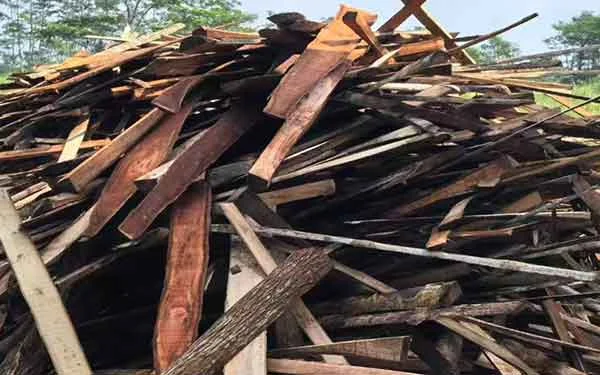
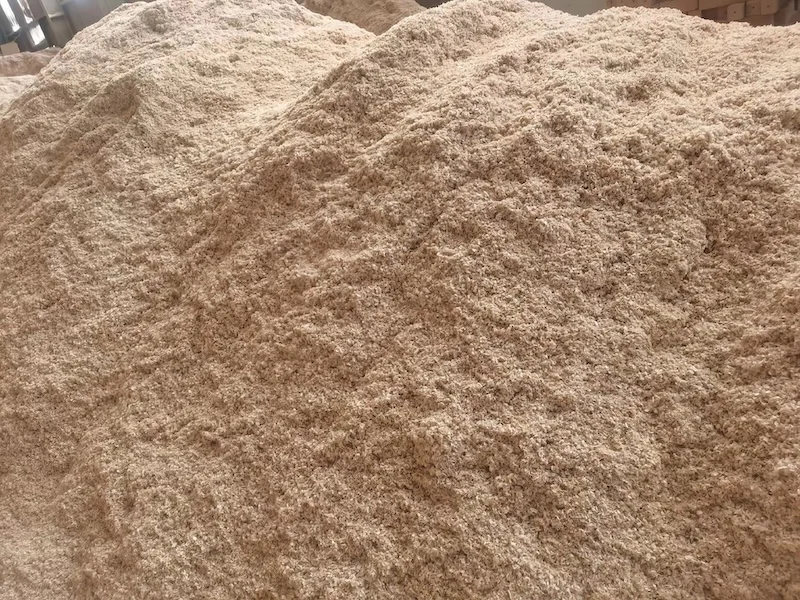
1.Raw Material Issues: The Most Easily Overlooked Reason
Based on our experience, over 20% of low pellet mill output problems are caused by raw material issues. Pellet mills are essentially “extrusion molding” equipment; the physical properties of the raw material directly determine whether it can be effectively pressed into the die holes.
1 ). Inadequate Moisture Content
Moisture Content Requirements
The ideal moisture content range for wood pelleting is 13% – 18%. For some softwoods, this can be relaxed to 20%, while hardwoods should be controlled at around 15%.
Wood pellet mill Running Performance
Moisture > 20%: Due to high temperature and compression, a water film forms on the inner wall of the ring die. During pelleting, the press rollers slip, preventing material from being squeezed into the ring die holes. This results in low pellet mill output and a large amount of white water vapor at the pellet mill feeding port.
Moisture < 10%: At too low a moisture content, lignin cannot fully soften and bind, resulting in loose pellets with a high powder content and low forming rate.
Solutions
Use a handheld moisture meter (a dedicated wood chip moisture meter with an accuracy of ±1% is recommended) to sample and test at multiple points.
Excessively Wet Wood Chips: Dry the wood chips using a drum dryer or air-dry them outdoors until the moisture content meets the standard.
Excessively Dry Wood Chips: Add water evenly using a misting nozzle while stirring. However, please note that the wood chips cannot be used immediately after adding water; they need to stand for 4-6 hours to allow the water to fully penetrate and evenly distribute before feeding them into the wood pellet mill.
Small Tips
The moisture content of wood swdust varies depending on the season. During the raining seasons, fresh wet sawdust can reach 50%-70% moisture content, while in winter, dry sawdust may fall below 10%. It is recommended to establish an incoming raw material inspection system and manage raw materials in batches.
2 ) Raw Material Size Mismatch
Requirement Standard
The average size of the pulverized wood chips should be half the diameter of the target particles. For example, to produce 8mm particles, the average pulverized wood chip size should be 4mm. Note that this is the average size, not the maximum size. This does not mean the pulverizer screen must have a 4mm aperture diameter. In practice, the screen aperture diameter needs to be adjusted according to the moisture content of the raw material and should be much larger than 4mm.
Wood Pelletizer Performance
Average wood sawdust size too big (>5mm): Cannot smoothly enter the chamfered area of the die, exacerbating wear on the ring die and press rollers, resulting in a 20-30% decrease in output.
Average wood sawdust size too fine (like flour): Insufficient friction between materials, sufficient long fibers, pellet not strong enough, high powder content, and low forming rate.
Solution
Check the pulverizer screen aperture and replace it with a suitable specification (8-10mm screen recommended).
Excessively Fine Pulverization: Add 20%-30% coarse fiber materials (such as wood shavings, coarse sawdust) to improve the gradation.
2.Pellet Mill Component Issues: Gap Between Pressure Roller and Ring Die
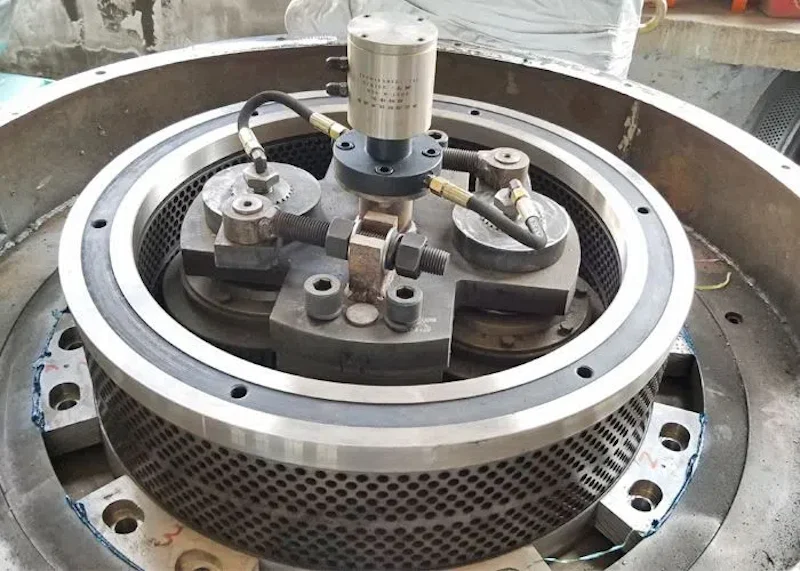
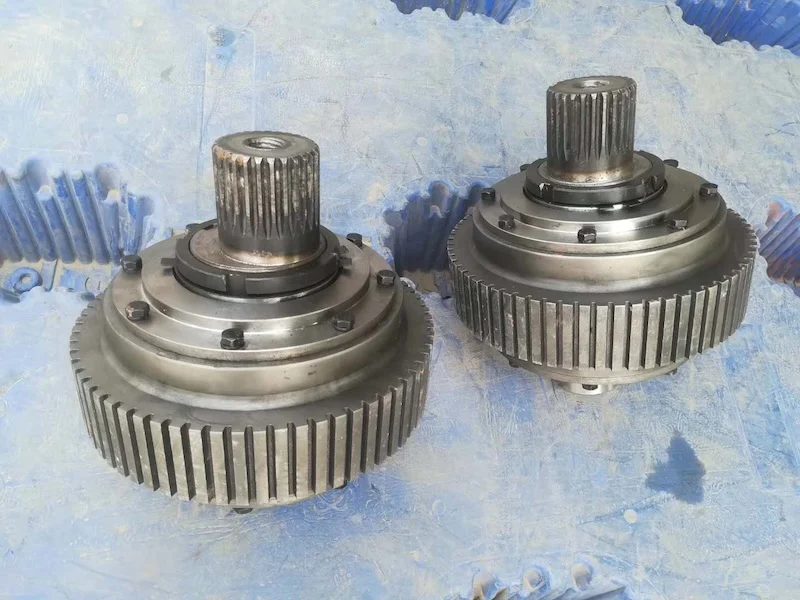
After ruling out problems caused by the raw material, potential issues often focus on three core components of the wood pellet mill.
1.) Improper Gap Between Pressure Roller and Ring Die (This is the most common pellet mill problem)
Working Principle:
Raw material sawdust is fed into the pelleting chamber of a vertical ring die pellet mill. As the press roller rotates, sawdust is evenly dispersed between the ring die and the pressure roller. The raw material is pressed into the ring die hole by the pressure roller. If the gap between the ring die and the pressure roller is too small, direct metal-to-metal friction will cause the die and pressure roller to overheat and wear excessively. If the gap is too large, the pressure roller will slip, failing to build sufficient pressure, and the raw material will be pressed into a cake-like layer adhering to the inner wall of the ring die, but no pellets will be discharged from the ring die hole.
Optimal Gap Between Pressure Roller and Ring Die
The ideal gap during operation is 0.1-0.5 mm. When manually rotating the pressure roller, a uniform, slight, almost-adherent friction force should be felt.
Step-by-step adjustment method (taking a vertical ring die pellet mill as an example)
a. Stop the pellet mill and disconnect the power. Clean all sawdust from the pellet forming cavity (make sure it is thoroughly cleaned, especially the part where the pressure roller contacts the ring die; manually rotate the mill and clean it thoroughly).
b. Loosen the eccentric shaft fixing bolts of the pressure roller.
c. Use a wrench to fine-tune the eccentric shaft of the pressure roller, gradually bringing the outer surface of the pressure roller closer to the inner wall of the ring die.
d. Manually rotate the pressure roller until you feel significant frictional resistance.
e. Reverse fine-tuning: Slightly reverse the adjustment to slightly increase the gap to a state of “friction but not tightness,” without affecting the rotation of the pressure roller.
f. Tighten all fixing bolts and manually rotate the pressure roller assembly 3-5 turns to confirm there is no jamming.
Note
When installing a new ring die for the first time, the gap should be set slightly larger (approximately 0.5mm). Gradually reduce the gap after a break-in period.
2.) Incorrect Ring Die Compression Ratio Selection
Technical Concept
Compression Ratio = Effective Length of Ring Die Hole ÷ Die hole Diameter. It determines the “journey” the material travels within the die orifice
Selection Principles
Softwood (Pine, Fir): Compression Ratio 5:1 – 8:1
Hardwood (Oak, Beech): Compression Ratio 3:1 – 6:1
Straw, Grass: Compression Ratio 4:1 – 7:1
Judgment and Solutions
Slow discharge wood pellets, the pellets are dark and hard, indicate an excessively high compression ratio; need to change a ring die with a lower compression ratio.
Pellet loose and unformed, with a lot of sawdust and powder indicate an excessively low compression ratio; need to change a ring die with a higher compression ratio.
3.) Ring Die Hole Wear (Chamfer Failure)
Wear Characteristics:
New ring dies have a “flared” chamfer or stepped hole at the entrance of each die hole to guide material in. After a period of use, the chamfer gradually wears down, and the die hole becomes a straight cylinder, reducing its gripping ability.
Inspection Method:
Touch the working surface of the ring die to feel if it is smooth (ideally, it should have a slightly rough feel).
Observe whether the edge of the die hole entrance is sharp or rounded.
Solution:
Mild Wear: Press with an oily material (wood chips + 5%-10% machine oil) under high pressure for 30-50 minutes for “self-sharpening” repair.
Severe Wear: When the die hole wall thickness has been excessively thinned, the ring die must be replaced.
4.) Loss of gripping force on the pressure roller surface, affecting sawdust feeding.
Problems
The press roller surface, originally textured or rough, becomes smooth and shiny after a period of use, causing a decrease in friction and resulting in slippage.
Solution
Replace the pressure roller sleeve directly: This is the most economical approach. Like the ring die, the pressure roller sleeve is a wear part.
Pay attention to the parallelism between the pressure roller sleeve and the inner wall of the ring die during installation; excessive deviation will lead to uneven wear.
3.Operational and Usage Issues: Pellet Mills Also Require "Proper Operation”
1 ). New Ring Die Not Effectively Grinded
Problem and Cause:
The inner wall of the new ring die hole has microscopic burrs and machining marks, resulting in high frictional resistance. Directly putting it into production will lead to low output, large current fluctuations, or even machine blockage.
Proper Ring Die Polishing Process (approximately 30-60 minutes):
a. Prepare oily break-in material: dry sawdust + waste machine oil (contact TCPEL for relevant video guidance), mix evenly, and control the moisture content at 12%-15%.
b. Adjust the pressure roller gap to the normal value.
c. Start the machine and feed in the break-in material, observing the output. Initially, there may be very little or no output, which is normal.
d. Gradually increase the feed rate and grind for 30-60 minutes.
e. When the output is smooth and the current is stable, stop feeding and let the machine idle for 1-2 minutes to discharge any remaining material.
f. Gradually switch to standard raw materials and resume normal production.
2 ). Uneven Feeding To the Pellet Mill
Problem Symptoms:
Material accumulates only on one side of the ring die, with almost no material on the other side, as seen through the observation window. This leads to uneven wear on the ring die and reduced output.
Causes and Solutions
Worn or incorrectly angled feed scraper: Stop the machine and adjust the scraper position to evenly distribute the material across the entire width of the ring die.
Material bridging at the feed inlet: Add a mixing device or arch breaker to the feed hopper.
Excessive metal impurities in the raw material: Inspect and clean the magnetic separator at the feed inlet.
4.Conclusion
Solving the problem of low output in wood pellet mills is essentially a systematic process of troubleshooting and eliminating possibilities one by one. Raw material moisture content and pressure roller gap are the two most common sources of failure and should be checked first. Wear and tear on the ring die and pressure rollers is normal; establishing a regular inspection and replacement system can effectively maintain efficient equipment operation.
If your equipment’s output does not recover after the above troubleshooting, please record the following information and contact our technicians:
· Raw material type and moisture content
· Ring die compression ratio and usage time
· Pellet output status (loose, hard, or no output)
Professional Service Tip: We provide custom ring dies, press roller shell accessories, and remote technical support. For further inquiries, please contact our technical team through the chat box.
CONTACT US NOW
We are one of the most professional pellet mill and briquette machine manufacturers with more than 20 years experience. You are welcome to contact us to discuss more details.
- The best design & quality machines
- Quick reply within 2 hours
- Provide the best proposal within 72 hours.
- Free test run service for special raw materials
- Decades of expertise, highly skilled team, tailored solutions.